

Psychiatric Service Dog for OCD: 4 Ways They Can Support Well-Being

Sarah Benitez-Zandi, MSW, LCSW, is a licensed clinical social worker in Wisconsin, Florida, Illinois, Ohio, Iowa, Pennsylvania, South Carolina, North Carolina, and Minnesota. She earned both her MSW and Bachelor’s in Social Work from the University of Wisconsin–Milwaukee. Sarah is the owner and operator of Milwaukee Mental Health & Consulting LLC, where she provides trauma-informed therapy, EMDR, perinatal mental health care, and evaluations for Emotional Support Animals (ESA) and Psychiatric Service Dogs (PSD). With experience as a mental health therapist, clinical manager, and medical social worker, she offers inclusive, culturally responsive telehealth care for individuals and couples navigating anxiety, trauma, life transitions, and relationship challenges.


Sarah Benitez-Zandi, MSW, LCSW, is a licensed clinical social worker in Wisconsin, Florida, Illinois, Ohio, Iowa, Pennsylvania, South Carolina, North Carolina, and Minnesota. She earned both her MSW and Bachelor’s in Social Work from the University of Wisconsin–Milwaukee. Sarah is the owner and operator of Milwaukee Mental Health & Consulting LLC, where she provides trauma-informed therapy, EMDR, perinatal mental health care, and evaluations for Emotional Support Animals (ESA) and Psychiatric Service Dogs (PSD). With experience as a mental health therapist, clinical manager, and medical social worker, she offers inclusive, culturally responsive telehealth care for individuals and couples navigating anxiety, trauma, life transitions, and relationship challenges.
Service dogs are animals trained to assist individuals with disabilities by performing tasks. For those with mental health conditions like Obsessive-Compulsive Disorder (OCD), these canine companions can provide critical support. They significantly enhance daily living.
An OCD service dog is more than just a pet. They are a dedicated partner in managing the symptoms of OCD. Through their specific training, these dogs help their handlers regain control. They help them improve their quality of life.
The presence of an OCD service dog offers both practical assistance and emotional comfort. It promotes a sense of security and well-being. These incredible companions have the power to transform lives. This post will explore all about PSDs for OCD.
What is a Psychiatric Service Dog (PSD)?
Service dogs are trained to perform tasks to aid individuals with physical disabilities (blindness, mobility issues). These tasks can vary depending on the needs of the owner, and the key aspect of a service dog is its specific training to support its owner’s independence and safety, providing physical health benefits.
A psychiatric service dog (or psychiatric service animal) is a specific type of service animal for supportive companion, trained to assist individuals with mental health disorders (OCD, depressive disorders, social phobias, bipolar disorder, post-traumatic stress disorder, anxiety) and also daily routines and overall well-being.
How Can an OCD Service Dog Help?
For people living with Obsessive-Compulsive Disorder (OCD), daily life can feel exhausting and unpredictable. Obsessions (intrusive thoughts, images, urges) and compulsions (rituals such as checking, washing, counting, reassurance-seeking) can consume time, disrupt routines, and increase distress—especially in triggering environments like crowds, public bathrooms, transit, or high-stress work/school settings.
A psychiatric service dog (PSD) can offer meaningful support when the dog is individually trained to perform specific tasks related to the person’s disability (not just comfort). This “trained task” requirement is what distinguishes a service dog from other support animals in many legal definitions and public-access contexts.
What a PSD can do that’s particularly relevant to OCD:
Interrupt Compulsive Loops
Many handlers train a PSD to interrupt repetitive behaviors or “stuck” moments that often show up in OCD (e.g., extended checking, repeated handwashing, tapping, counting). Interruption can be trained as:
- A nudge with the nose or paw
- Placing the body between the handler and the trigger/object
- Initiating a learned “check-in” behavior that breaks the loop
Organizations and PSD training communities commonly describe interruption/redirect tasks as part of the psychiatric service dog task toolkit.
Grounding and Nervous-System Regulation
Some people with OCD experience intense anxiety spikes, sensory overload, or distress when resisting compulsions. A PSD can be trained to provide grounding (bringing attention back to the present) and Deep Pressure Therapy (DPT) (pressure/weight contact on cue) to help the handler regulate during acute distress.
Examples of trained responses:
- DPT on lap/legs when the handler sits down,
- “Lean” or close body contact to reduce panic intensity,
- A trained routine (touch → eye contact → follow → sit) that anchors attention.
Practical Daily-Life Support
In day-to-day life, a PSD can reduce the friction points that make OCD worse by helping the handler function more smoothly and independently. Depending on needs, tasks can include:
- Creating space (“crowd control”/buffering) in tight lines or crowded settings,
- Guiding to an exit or quieter area when overwhelmed,
- Retrieving items (phone, medication pouch, coping kit),
- Bringing the handler to a support person at home (if trained appropriately).
Supporting Evidence-Based Treatment
The most established first-line psychotherapy for OCD is Exposure and Response Prevention (ERP), a specialized form of CBT where people gradually face triggers while resisting compulsions, with clinician guidance and a structured plan.
A PSD can be most helpful when its training is designed to support ERP goals (e.g., grounding while the handler sits with anxiety, or helping leave a triggering setting without completing rituals), instead of unintentionally becoming part of the compulsion (like repeated reassurance behaviors).
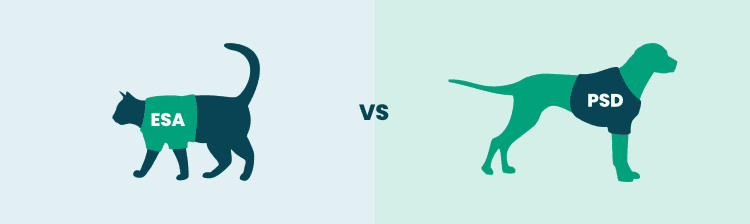
ESA vs. PSD
The primary distinctions between psychiatric service dogs and emotional support dogs lie in the level of training and the legal rights each type of dog has.
Psychiatric Service Dogs (PSDs) are trained to perform disability-related tasks that directly help with a person’s psychiatric condition (such as OCD). While the relationship can also bring powerful emotional benefits, the defining feature is task training. By contrast, emotional support dogs provide comfort and companionship but are not trained to perform specific tasks that assist with a disability.
How to Get a Psychiatric Service Dog for OCD
Getting a psychiatric service dog (PSD) for OCD usually works best when you follow a structured, realistic plan.
1. Obtain a Diagnosis and Document Functional Needs
Start with a formal OCD diagnosis from a licensed healthcare professional (psychiatrist, psychologist, or primary care provider who can document it). Beyond the label, what matters most is how OCD limits your daily functioning.
What to do:
- Ask your provider to help you describe your impairment in practical terms (e.g., time lost to compulsions, difficulty leaving home, inability to focus at work/school, panic in trigger environments).
- Clarify the specific moments where a trained dog could help (e.g., breaking checking loops, grounding during exposure work, retrieving meds, guiding you out of overwhelming environments).
If you’re in treatment (especially ERP), talk about how a dog could support the plan rather than accidentally becoming part of a compulsion (like reassurance-seeking).
2. Select a Suitable Dog
Choosing the right dog is not just about liking a breed, it’s about picking an individual animal with the temperament and health needed for public access and consistent task work. There are no limitations to the breed of dog that can be used as a psychiatric service dog, as long as the dog is specially trained to perform certain tasks.
What to look for in the dog:
- Calm, stable nerves (not easily startled)
- People-neutral and environmentally confident (handles crowds, noises, new places)
- Social but not overly reactive or needy
- Motivated to work (enjoys training, food/toy drive can help)
- Strong physical health and sound structure

3. Ensure Psychiatric Service Dog Training
A psychiatric service dog must be trained to perform specific, reliable tasks that mitigate OCD-related disability, not simply provide comfort.
Examples of OCD-relevant tasks:
- Interruption/redirect: nudging or alerting when you start a compulsion (checking, washing loops), then guiding you into a trained alternative behavior.
- DPT/grounding on cue: applying pressure or close contact to help regulate anxiety during spikes or exposure exercises.
- Item retrieval: bringing medication, phone, coping kit, water, or a written plan.
- Guiding to an exit / finding a safe spot: leading you to a quieter area when you’re overwhelmed.
- Routine support: structured prompts that keep you moving through steps without getting stuck.
Training options:
- Program dog from an organization (often highest reliability, longer wait, higher cost).
- Owner-trained with a professional trainer’s support (more flexible, requires time and consistency).
- Hybrid approach: adopt a candidate dog and train with a service-dog specialist.
4. Get Your Legit PSD Letter in ESA Pet
Getting a PSD letter is a simple process, and this document will ensure your piece of mind. With ESA Pet, obtaining a legitimate PSD letter is easy and efficient:
- Start with a brief pre-screening to check your eligibility for a PSD letter. This questionnaire gathers information about your psychiatric condition.
- ESA Pet then connects you with a licensed professional for a detailed evaluation. During this telehealth session, you’ll discuss your mental health condition, its impact on your daily life, and how your trained service dog assists you.
- Once approved, you’ll receive your signed PSD letter on official letterhead. You will receive this letter digitally within three business days.
Get your Official PSD Letter Consultation from a licensed therapist.
How to Train a Service Dog for OCD?
Training a service dog for OCD patients involves a detailed and rigorous process. This helps to ensure the dog can effectively assist its handler. The training generally follows two main components:
1. General Public Access Training
This step ensures that the service dog behaves appropriately in public settings. The dog learns basic commands and how to remain calm in various environments. The General Public Access Test is often used to assess a dog’s ability to navigate public spaces without causing disruptions.
2. Specialized Task Training
After mastering public access skills, the psychiatric service dog undergoes specialized training. This training is tailored to the handler’s specific needs. This involves teaching the dog to perform tasks related to managing the OCD symptoms. The dog can learn to interrupt compulsive behaviors or provide DPT during an anxiety attack. This specialized training ensures the dog can address its handler’s disability.
PSD Dogs for OCD FAQs
Yes. OCD can qualify someone for a psychiatric service dog (PSD) when the condition substantially limits daily functioning and the dog is trained to perform specific tasks that mitigate OCD symptoms. In the U.S., PSDs have legal protections under the Americans with Disabilities Act (ADA), which generally allows them to accompany their handler in public spaces where the public is permitted, as long as the dog is under control and task-trained.
It depends on what you need. A pet dog may offer comfort and routine, but a PSD is the better fit if you need reliable symptom-related support and practical help in real-world settings.
People often report mental health benefits from working with a PSD, including greater confidence leaving home and improved day-to-day stability, but it also requires long-term commitment, consistent handling, and often extensive training to keep skills dependable. Therapy dogs are different from PSDs, since they’re typically trained to support other people in community settings rather than perform disability-related tasks for one handler.
Training usually combines public-access manners (calm, focused behavior around distractions) with specialized task work designed around OCD patterns and triggers. Proper training often takes months to years because the dog must generalize skills across many environments and remain steady under stress.
Professional trainers commonly use positive reinforcement methods and tailor task training to the handler’s symptoms and preferences, which helps create more consistent behavior and reduces the chance the dog accidentally reinforces compulsions.
Yes. Many PSDs can be trained to provide deep pressure therapy (DPT) on cue or in response to agreed-upon signs of distress, which some handlers find helpful for regulating anxiety and staying grounded. DPT is most effective when it’s part of a broader plan, ideally aligned with treatment goals,rather than used as a replacement for clinical care.
Yes, if panic attacks are part of your symptom profile, a PSD can be trained to respond with specific, repeatable tasks such as initiating grounding contact, guiding you out of overwhelming situations, or providing DPT when appropriate. The key distinction is that the dog’s assistance must come from trained tasks rather than generalized comfort.
A service dog trained to mitigate anxiety-related disability is commonly called a psychiatric service dog (PSD). The term matters because it emphasizes task training and supports the legal distinction between PSDs and animals that provide comfort without disability-related task work.
No. Therapy dogs are generally trained to provide comfort to others in places like hospitals or schools and typically do not have the same public-access rights as PSDs under the ADA. A PSD is defined by trained disability-related tasks and, when properly trained and handled, is the category that receives ADA public-access protections.
The best dogs for OCD are usually the ones most likely to succeed as psychiatric service dogs: calm, stable, people-neutral, easy to train, and able to work reliably in public without becoming reactive or overly sensitive. In practice, that’s why Labrador Retrievers and Golden Retrievers are so common, but standard Poodles are another strong option, especially for people who prefer a lower-shedding coat, and many well-selected mixed-breed dogs can be excellent if they have the right temperament and health.
Conclusion
OCD service dogs are invaluable for individuals with Obsessive-Compulsive Disorder (OCD). These trained animals help manage symptoms, interrupt compulsive behaviors, and provide DPT. Their presence significantly enhances the quality of life for their handlers.
The bond between an OCD service dog and its handler is unique and profound. Recognizing the transformative power of an OCD service dog changes the perspective. It highlights them as loyal companions capable of making a difference in managing OCD.

Update Notes
Feb. 18, 2026: This article was medically reviewed by Sarah Benitez-Zandi
Mar 09, 2026: Updated the entire content with new, relevant and direct content related to OCD service animals.
Sources
Americans with Disabilities Act. (n.d.). ADA requirements: Service animals. U.S. Department of Justice. Retrieved March 5, 2026, from https://www.ada.gov/resources/service-animals-2010-requirements/
Americans with Disabilities Act. (n.d.). Service animals. U.S. Department of Justice. Retrieved March 5, 2026, from https://www.ada.gov/topics/service-animals/
Americans with Disabilities Act. (n.d.). Frequently asked questions about service animals and the ADA. U.S. Department of Justice. Retrieved March 5, 2026, from https://www.ada.gov/resources/service-animals-faqs/
Freedom Service Dogs. (n.d.). What is deep pressure therapy? Retrieved March 5, 2026, from https://freedomservicedogs.org/wag/deep-pressure-therapy/
Hope Service Dogs, Inc. (n.d.). Psychiatric service dogs. Retrieved March 5, 2026, from https://hopeservicedogs.org/psychiatricsd
International OCD Foundation. (n.d.). Exposure and response prevention (ERP). Retrieved March 5, 2026, from https://iocdf.org/ocd-treatment-guide/exposure-response-prevention/
Hezel, D. M., & Simpson, H. B. (2019). Exposure and response prevention for obsessive-compulsive disorder: A review and new directions. Indian Journal of Psychiatry, 61(Suppl 1), S85–S92. https://doi.org/10.4103/psychiatry.IndianJPsychiatry_516_18 (Retrieved March 5, 2026, from https://pmc.ncbi.nlm.nih.gov/articles/PMC6343408/
Psychiatric Service Dog Partners. (n.d.). Work & task list for psychiatric service dogs. Retrieved March 5, 2026, from https://www.psychdogpartners.org/resources/work-tasks/work-task-list

Psychiatric Service Dog, Service Animals, Service Dog Types and Breeds
Siberian Husky Service Dog: Training, Ho...

Jonalyn Dionio
Jan 7 2026

Psychiatric Service Dog, Service Dog Disabilities
Service Dog for Panic Attacks: Can They ...

Andre Gregatti
Dec 17 2025


